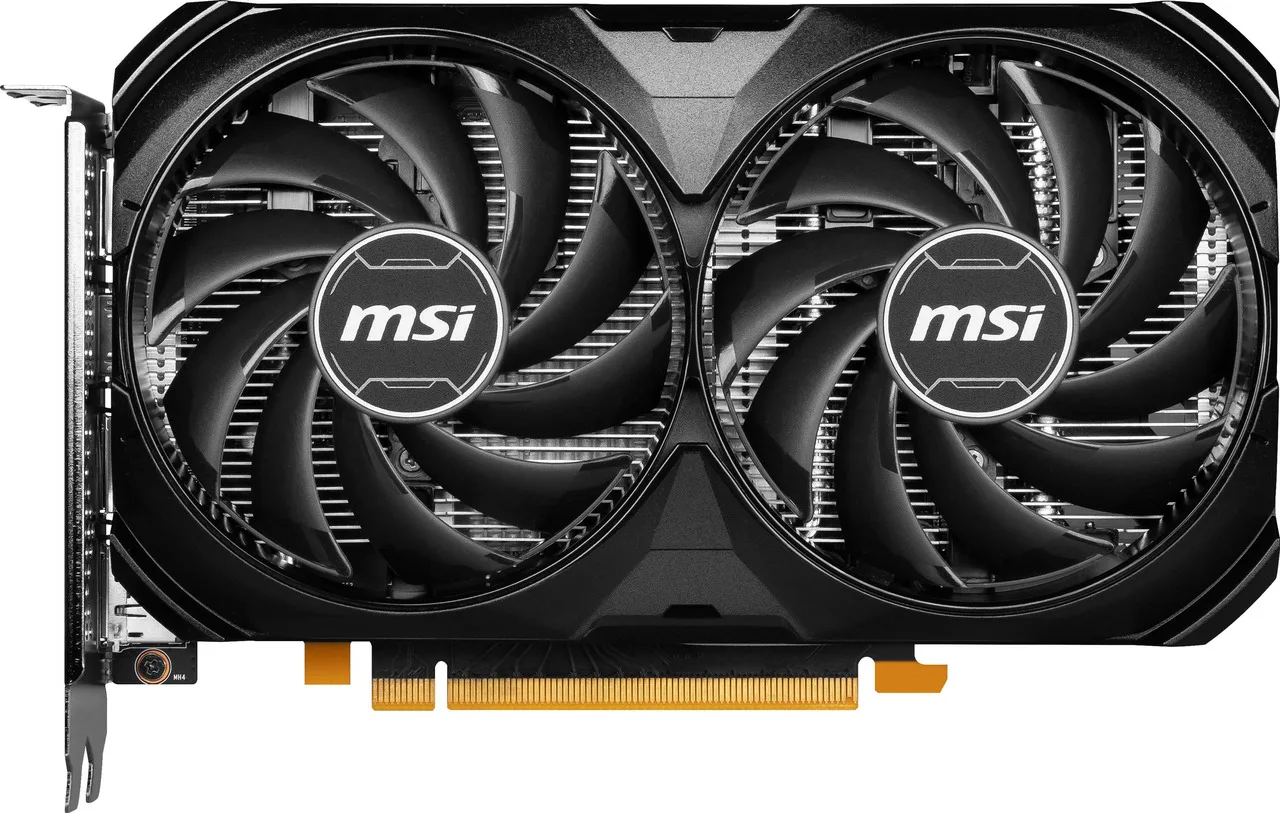
| Spec | RTX 4060 8GB | RX 7600 XT 16GB |
|---|---|---|
| VRAM | 8GB GDDR6 | 16GB GDDR6 |
| Memory bus | 128-bit | 128-bit |
| Bandwidth | ~272 GB/s | ~288 GB/s |
| Boost clock | 2.46 GHz | 2.76 GHz |
| TDP | 115W | 190W |
| Upscaling | DLSS 3 + Frame Generation | AMD FSR / FidelityFX |
| Launch MSRP | $299 | $329 |
The two cards, side by side
Both cards launched within $30 of each other — the RTX 4060 at $299, the RX 7600 XT at $329 — and both target the same buyer: someone stepping up to 1440p without a high-end budget. Street pricing has moved around a lot since, and the two cards trade the "cheaper" title back and forth depending on the retailer and the week, so treat any specific dollar figure here as a snapshot, not a promise. What doesn't move is the spec sheet, and that's where the real decision lives.
On paper, the RX 7600 XT's 16GB of VRAM — double the RTX 4060's 8GB — looks like the deciding factor. Both cards share the same 128-bit memory bus and a near-identical die (AMD's Navi 33, the same silicon used in the non-XT RX 7600, just with double the memory chips). But raw VRAM capacity isn't the whole story once you look at what each card actually does with a frame.
Check RTX 4060 price on Amazon → · Check RX 7600 XT price on Amazon →
Spec-for-spec comparison
| Spec | RTX 4060 | RX 7600 XT |
|---|---|---|
| VRAM | 8GB GDDR6 | 16GB GDDR6 |
| Memory bus | 128-bit | 128-bit |
| Bandwidth | ~272 GB/s | ~288 GB/s |
| Boost clock | 2.46 GHz | 2.76 GHz |
| TDP | 115W | 190W |
| Upscaling | DLSS 3 + Frame Generation | FSR / FidelityFX |
| Launch MSRP | $299 | $329 |
The TDP gap is the number that matters most in daily use: the RX 7600 XT draws 75W more than the RTX 4060 under load — a 65% jump. That's not just an electricity-bill footnote. It means a hotter card, a louder fan curve on cheaper coolers, and less thermal headroom in a budget case with mediocre airflow. It also matters for the budget build this card slots into: the RTX 4060 leaves more of a 550–650W PSU's headroom for the rest of the system.
Independent testing across broad multi-game suites has the two cards landing within a few percent of each other on raw average frame rate — close enough that neither wins on rasterization alone. Where they actually separate is upscaling: the RTX 4060 supports DLSS 3 Frame Generation, which in supported titles inserts AI-generated frames to noticeably smooth out gameplay at 1440p, something the RX 7600 XT's FSR/FidelityFX stack doesn't match feature-for-feature yet. In games without Frame Generation support, the RX 7600 XT's slightly higher boost clock gives it a small raw-rasterization edge.
Where the 16GB actually pays off
The RX 7600 XT's extra VRAM isn't marketing filler — it matters for a specific buyer. If you run texture-heavy modded games, do light video editing or AI work on the side, or just want a GPU that ages further into the late 2020s without downgrading texture settings, 16GB is real insurance. For a pure 1440p gaming build with no side workloads, most current titles at "high" (not "ultra") settings don't come close to saturating 8GB — the gap shows up mainly in a handful of texture-heavy AAA releases pushed to their maximum settings.
Decide in sixty seconds
If you want the answer without the reasoning, answer these in order and stop at the first yes.
- Do you play heavily modded games, or use the GPU for video work or AI on the side? → RX 7600 XT. This is what the 16GB is for.
- Is your case small, poorly ventilated, or is noise something you actively care about? → RTX 4060. Seventy-five watts is a lot of heat to put in a sealed box.
- Do the specific games you play support DLSS 3 Frame Generation? → RTX 4060. This is where the gap actually opens.
- Is one of them meaningfully cheaper right now? → Take that one. At this level of parity, price is a legitimate tiebreaker.
- None of the above? → RTX 4060, as the lower-risk default.
What benchmark charts do not capture
Review numbers are produced on an open bench with a good cooler. Three things change the picture on a real desk:
- Cooler quality varies more within a model than between models. A two-fan budget RTX 4060 and a three-fan premium one differ by more than the RTX 4060 differs from the RX 7600 XT. On the AMD card, which has 75W more heat to move, that variance matters more.
- Case airflow decides sustained clocks. Both cards boost well in a fifteen-second benchmark run. An hour into a session, in a case with one exhaust fan, the hotter card is the one that settles lower.
- The software stack is part of the product. Driver update cadence, control-panel features, upscaling support in the specific games you play — none of it appears on a spec sheet, and all of it is part of what you live with.
The third option this comparison leaves out
If you arrived here to settle a two-way choice, it is worth knowing that a third card sits between them on value: the Intel Arc B580, with 12GB of VRAM — more than the RTX 4060, less than the RX 7600 XT — usually at a lower price than either.
It is not a universal recommendation. Intel's drivers have improved enormously but still show rough edges in some older titles, which is exactly the kind of risk that does not appear in an average frame rate. If your library is modern, it is the sharpest buy in this bracket; if one specific older game is the reason you are upgrading, stay with one of the two cards here. The full reasoning is in our budget GPU rankings.
If you already own one of these
Neither card is worth replacing with the other. They are close enough in performance that swapping sideways costs you money for a rounding error.
What is worth doing instead:
- On the RTX 4060, if you are hitting VRAM limits: drop textures one notch before considering a new card. The visual difference at 1440p is usually smaller than people expect, and the stutter it removes is not.
- On the RX 7600 XT, if the card is loud: the fix is almost always case airflow, not the GPU. Adding a front intake fan is a fraction of the price of a new card and often solves the complaint entirely.
- On either, if you want more frames: check whether your CPU is the limit first. At 1080p especially, it frequently is.
Final verdict
For most budget 1440p buyers, the RTX 4060 is the better default: DLSS 3 Frame Generation closes — and in supported titles reverses — the RX 7600 XT's raw performance edge, while running dramatically cooler and quieter. Pick the RX 7600 XT only if the extra VRAM matters for your specific use case, or if it's meaningfully cheaper than the 4060 at the exact moment you're buying — pricing between these two flips often enough that it's worth checking both before you commit.
Check RTX 4060 price on Amazon → Check RX 7600 XT price on Amazon →
FAQ
Is 8GB of VRAM enough in 2026? For 1440p high (not ultra) settings in the large majority of current titles, yes. It becomes a limiting factor in a handful of texture-heavy AAA releases pushed to maximum settings, or if you run modded texture packs on top.
Does DLSS 3 Frame Generation actually feel good? In supported titles, yes — it's most convincing above roughly a 50fps base frame rate, which both of these cards comfortably clear at 1440p high in most games.
Why is the RX 7600 XT $30 more expensive at launch but sometimes cheaper today? GPU street pricing is volatile and driven by retailer stock, not MSRP — always compare current listings rather than launch prices before buying either card.
Sources
- Manufacturer spec sheets — NVIDIA and AMD official product pages and press materials
- Launch pricing and specifications — VideoCardz, NVIDIA Newsroom
- Aggregated multi-game 1440p performance comparisons — DatabaseMart, Dropreference, Digital Trends
For most 1440p buyers on a budget, the RTX 4060 is the safer pick: DLSS 3 Frame Generation and 75W less heat and power draw outweigh the RX 7600 XT's extra VRAM for anyone gaming at 1440p high (not ultra) settings today. Buy the RX 7600 XT instead if your PSU/case airflow headroom is generous and PSU wattage isn't a constraint, or if you specifically need the extra VRAM for texture-heavy mods, video work, or AI workloads on the side.
Wins on
- RTX 4060 wins on: DLSS 3 Frame Generation in supported titles
- 115W draw — quieter, cooler, cheaper to run all year
- No Founders Edition tax — wide choice of compact partner cards
Trade-offs
- RX 7600 XT wins on: 16GB VRAM — real headroom past 2027
- Slightly higher raw rasterization clock-for-clock
- No upscaling license lock-in (FSR runs on any GPU)